By Sadiq Mohammad
As someone who has spent a lifetime in cricket and opened the innings for Pakistan at the highest level, I feel compelled to speak about a growing concern in our coaching philosophy. Watching the way modern practice sessions are conducted, I increasingly believe that we are relying far too heavily on throwdowns. At the level international cricket is played today, excessive throwdown practice does not truly develop batsmanship.
In my view, throwdowns are the easiest way to give the appearance of hard work. To an outsider watching a training session, it may look impressive, batsmen repeatedly striking ball after ball with intensity. But real batsmanship is not developed that way. Cricket is a game of judgement, timing, adaptability and reading the bowler and those skills cannot be properly sharpened through repetitive throwdowns.
I strongly believe that even fifteen minutes of proper net practice against bowlers delivering at different speeds and lengths can teach far more than long sessions of throwdowns. When a batsman faces bowlers who vary their pace, seam position and length, he is forced to make real-time decisions. He learns shot selection. He adjusts his footwork. He reads the length of the ball and reacts instinctively. These are the skills that build a complete batsman.
Excessive throwdowns, on the other hand, condition the body and mind to a predictable rhythm. When the ball is repeatedly delivered from a short distance with similar trajectory, the batsman’s judgement of length becomes compromised. Footwork movements become mechanical. The body gets used to one momentum, which does not reflect the realities of match situations where bowlers constantly change pace, line and strategy.
That does not mean throwdowns have no place in training. They can be useful when used in moderation. For example, five to seven balls to rehearse specific strokes such as the pull shot or the cut shot can be beneficial. These are targeted drills meant to sharpen particular movements. But when batsmen are facing twenty-five to forty throwdowns practicing front-foot and back-foot drives, the exercise begins to lose its value as genuine match preparation.
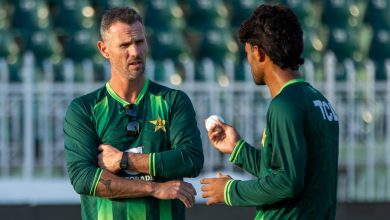
This brings me to a larger concern regarding coaching. If a cricket board is paying a foreign coach between fifteen and twenty thousand US dollars a month, along with various perks, the expectation should be much higher than supervising throwdown sessions. A coach at that level should be teaching the finer points of the game. He should be working on a player’s technique, improving his approach to an innings and developing tactical awareness.
Batting is not just about hitting the ball well in the nets. It is about understanding the rhythm of a match. It is about constructing an innings, building partnerships and controlling the tempo of the game. A true batting coach should guide players on how to chase targets under pressure, how to rotate the strike when boundaries are difficult and how to manage the final overs of a tight match.
The same principle applies to bowling. A quality coach should help bowlers understand how to use the crease to generate swing, how to vary their angles of delivery and how to increase pace through improved technique and conditioning. These are the advanced aspects of cricket that separate average teams from champion teams.
Unfortunately, what I observe today is that even our local coaches who travel with the team as specialist batting coaches appear to spend much of their time conducting throwdown drills. For the last three to four years, this pattern seems to have continued without significant emphasis on deeper technical and tactical development.
If all three members of the coaching group—local specialists and the foreign head coach—are primarily engaged in throwdown routines, then we must ask an honest question: who is actually identifying and correcting the technical flaws in our players? Who is working on their mental approach to the game? Who is teaching them how to think strategically in pressure situations?
At the highest level, coaching is not about feeding balls to batsmen. It is about shaping cricketers, improving their decision-making, sharpening their instincts and preparing them for the challenges of international competition.
This discussion becomes even more relevant now as Pakistan prepares to begin a three-match One Day International series in Bangladesh at the Sher-e-Bangla Stadium. Tours like these test a team’s adaptability and tactical awareness. Conditions change, pressure mounts and matches often come down to the final overs.
In those moments, technique alone is not enough. Batsmen must know how to plan a chase, how to calculate risk and how to stay composed when the target seems just within reach. These are lessons that cannot be learned through endless throwdowns.
Pakistan has always produced naturally gifted cricketers. What we need now is a coaching structure that refines that talent with proper technical guidance and tactical education. The goal should not simply be to make players look good in practice sessions but to prepare them to win matches.
That is the difference between activity and development and it is a difference we must recognize if we want Pakistan cricket to progress.
Note: Sadiq Mohammad is a former Pakistan Test opener.