By our correspondent
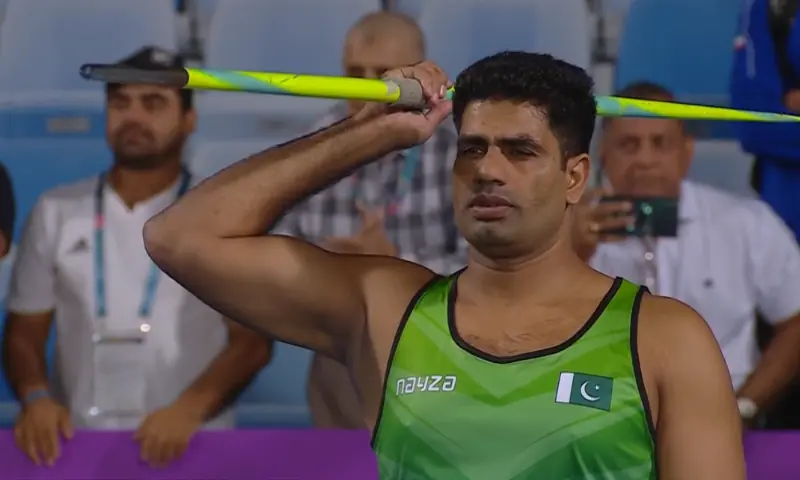
LAHORE: Following a disappointing tenth-place finish at the recent World Athletics Championships in Tokyo Olympic gold medallist Arshad Nadeem has resumed his training in preparation for the upcoming Islamic Solidarity Games scheduled to take place from November 7 to 21 in Riyadh, Saudi Arabia.
“Yes, we have resumed training at the Punjab Stadium,” Arshad’s coach Salman Butt said.
Arshad could only register a best throw of 82.75 metres in Tokyo placing tenth among the 12 finalists in what proved to be a highly competitive global event.
Coach Salman Butt later told Nukta that Arshad’s performance was hindered by fitness concerns, which were exacerbated by the hot and humid conditions in the Japanese capital.
Arshad’s calf had tightened a bit and that impeded his progress in the global event.
At the championship Keshorn Walcott of Trinidad and Tobago clinched gold medal with a throw of 88.16 metres. He was followed by Grenada’s former two-time world champion Anderson Peters (87.38m), who secured silver, and the USA’s Curtis Thompson (86.67m), who earned bronze. India’s reigning world and former Olympic champion Neeraj Chopra also struggled, managing a throw of 84.03 metres to finish eighth overall.
With just under a month left until the Islamic Solidarity Games, concerns remain about whether Arshad will be able to regain peak fitness in time.
“We will monitor his progress closely. At the moment, we are training once a day and gradually we will increase the intensity,” Butt said adding that Arshad is currently feeling physically well and mentally positive.
If decided to compete, Arshad will be defending his title at the Islamic Games where he remains Pakistan’s prime contender for a gold medal.
In the last edition of the Islamic Games held in Turkey in 2022 Arshad produced a remarkable throw of 88.55 metres which not only earned him gold but also set a new Games record. Just a week prior to that event he had rewritten the Commonwealth Games record in Birmingham with a massive throw of 90.18 metres, a career milestone that established him firmly among the sport’s elite.
Arshad’s journey in international athletics has been marked by consistent progress. After winning a bronze medal at the 2016 South Asian Games in India he has gone from strength to strength. His crowning achievement came at the 2024 Paris Olympics where he captured gold with a record-breaking throw of 92.97 metres setting a new Olympic benchmark.
He also secured a silver medal at the 2023 World Athletics Championships in Budapest, registering an impressive throw of 87.82 metres narrowly missing gold to Neeraj Chopra’s 88.17 metres.
Looking ahead Arshad has a packed competitive calendar in 2026 including the Commonwealth Games and Asian Games. While he has already tasted success at the Olympics, Commonwealth Games, Islamic Games and the Asian Athletics Championships, a gold medal at the Asian Games still eludes him.
Arshad had been scheduled to compete in the 2023 Asian Games in Hangzhou but was forced to withdraw at the last minute due to injury. With his proven capability and resilience many believe the Tokyo Asiad in 2026 could be the platform for him to complete his continental medal collection.