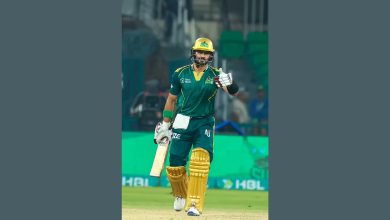
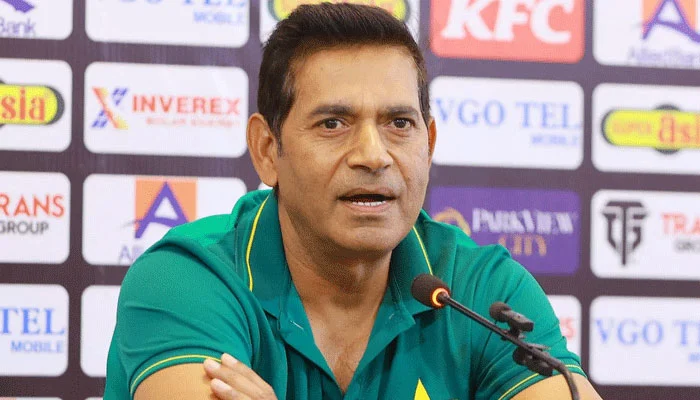
Aaqib Javed raises concerns over Babar, Fakhar injuries
The former Pakistan pacer and senior selector requests the PCB to conduct an inquiry into why these players are injured.

Our Web Desk
LAHORE: Pakistan’s senior selector Aaqib Javed on Saturday revealed that former captain Babar Azam and opener Fakhar Zaman are currently dealing with injuries and called for an inquiry into the circumstances that led to their fitness issues.
Addressing a press conference in Lahore, Aaqib said Babar was keen to take part in Bangladesh series and the national T20 event in Pakistan but was ruled out after medical assessment.
“When Babar returned and he was assessed by the doctor, his injury did not allow him to play the series or the T20 event in Pakistan despite the fact that he wanted to play,” he said.
Aaqib added that Fakhar Zaman is also injured and urged the Pakistan Cricket Board (PCB) to investigate how both players sustained injuries, particularly in relation to their recent participation in the T20 World Cup.
“We have requested the PCB to conduct an inquiry as to why these two players are injured,” he said. “Was their fitness not being properly monitored during the World Cup, or were they not fully fit when they were part of the World Cup squad?”
He emphasized that the selection committee must be kept fully informed about players’ fitness conditions.
“The selection committee should know about it, and the head coach and physio must have that knowledge and keep the selectors informed about any fitness concerns,” he added.
The senior selector also shed light on the Pakistan Cricket Board’s selection process and decision-making during international series.
Speaking about how team selections have evolved in recent months, Aaqib explained that discussions about the selection committee’s role began during Pakistan’s home Test series against England.
He said that when he joined the PCB, preparations for the series in Multan were already underway.
“When I came to the PCB, the task in Multan was going on as the England series was in operation,” Aaqib said. “We went to meet head coach Jason Gillespie to know about his plans for the second and third Test.”
According to the former Pakistan pacer, the selectors had suggested altering the pitches and considering more spin options for the remaining matches. However, Gillespie indicated that the 15-member squad had already been finalized and he was not in favour of making changes.
Aaqib said the situation prompted discussions within the PCB about the balance of authority between the coaching staff and the selection committee.
“We felt that it was not about personal ego, but it was also not appropriate to tie our hands simply because we had signed a contract with someone,” he said.
Following those deliberations, it was decided that the selection committee should have a more active role in shaping the playing XI during an ongoing series if changes were required to improve the team’s chances of winning.
“After that England series, we had a series in Australia which Pakistan won and the playing XI for every match was decided collectively by the captain, the head coach, and the selection committee,” he said.
Aaqib noted that the same collaborative approach continued in subsequent tours and tournaments.
“In the meantime I also served as coach for a few months. Whenever we toured, including the tour of South Africa — and even during the ICC Champions Trophy, the playing XI was decided by the coach and captain with mutual consensus from the selection committee,” he added.
The senior selector stressed that the PCB later moved to appoint a full-time professional coach but still aimed to maintain coordination between the coaching staff and selectors.
“We did not want a situation where a coach comes in and has no freedom to make decisions. There has always been an understanding that we would provide a larger pool of players,” he said.
He explained that the selectors typically provide squads of 18 to 20 players and before the most recent series the coaching staff had been given a pool of 21 players from which the final playing combinations were discussed jointly.
“We sit with the coach so that the best possible team can be selected,” he said.
However, Aaqib expressed concern about what he described as increasing personal criticism around selection matters, particularly after Pakistan’s recent results failed to meet expectations.
“In the meantime we see personal attacks being made. We do not respond to such things, especially when the team has not produced the performances expected of it,” he said.
Looking ahead, he suggested that a clearer structure could reduce confusion.
“When the coach returns, we will sit with him and discuss policy. If the coach and selectors jointly form a 15-member squad, it would be a better system,” he said. “At the moment we sometimes provide a 20-member pool and the coach selects 15 from it, and people outside do not know whom to question.”