Legend Ronaldo leaves football world shocked with his retirement
The announcement comes via a pre-recorded video days after falling out with his head coach

Cristiano Ronaldo quits his Portugal duty on Thursday, a revelation which left the world football highly dejected. He was an icon of the game and the man with super nerves and top working ethics which shaped his two-decade long illustrious career.
Following 23 years, 234 appearances and a world-record 146 goals, Cristiano Ronaldo eventually decided that it’s time to quit months after Argentina great Lionel Messi left the world football. His Portugal career was a story of impossible expectations, spectacular defiance, heartbreak and, finally, a triumph he had to watch from the touchline.
There are footballers who represent a country, and then there are footballers who become part of the way a country sees itself. For 23 years, Cristiano Ronaldo was both for Portugal.
He arrived as a teenager with quick feet, a restless appetite for the ball and a shirt number that would eventually become a global trademark. He leaves at 41 as the most prolific goalscorer and most-capped player in men’s international football, carrying records that may outlast the career itself.
On Thursday, Ronaldo announced that he was retiring from international football, bringing an extraordinary journey that began in August 2003 to a close. His final figures are almost difficult to comprehend, a collection of milestones that place him beyond every other man to have played the international game.
“To the Portuguese people, the day has come for me to hand back the number seven shirt of our national team,” he said in a video posted on Instagram.
“I never felt it belonged to me alone, but for 23 years I had the privilege and the responsibility of wearing it, defending it and carrying it with me into stadiums all around the world.”
The announcement carried the language of gratitude, but also the unmistakable sadness of an ending. Ronaldo acknowledged the victories, the defeats and his own mistakes. Above all, he insisted that his pride in representing Portugal had never diminished.
It was a fitting sentiment for a career in which the country’s hopes often seemed to rest on his shoulders.
The first image of that journey belongs to Euro 2004. Ronaldo, still a teenager, was part of a Portugal side that reached the final on home soil, only to lose 1-0 to Greece. The defeat was painful, made more so by the sight of a young Ronaldo crying at the end. He had tasted the demands of international football before he had fully understood its rewards.
Two years later, Portugal reached the World Cup semi-finals in Germany, their best finish since 1966. Ronaldo was no longer simply a promising winger. He was becoming the face of a generation expected to deliver the trophy that had eluded the country.
There were nights when he seemed capable of carrying that expectation alone. In November 2013, with Portugal facing Sweden in a World Cup play-off, he scored a hat-trick in the second leg in Stockholm. Zlatan Ibrahimovic had scored twice to give the hosts hope, but Ronaldo answered with three goals of his own, including two in the closing stages, to send Portugal to the 2014 World Cup.
Then came the night that changed the meaning of his career.
The final he won from the sidelines
Portugal’s triumph at Euro 2016 was not a story of Ronaldo scoring the decisive goal. It was a story of a captain who could not finish the match.
Portugal had stumbled through the group stage, drawing all three games, before finding their way into the final against hosts France in Paris. Ronaldo’s tournament ended after 25 minutes when a knee injury forced him off. He left the pitch in tears, his face reflecting the fear that the biggest opportunity of his international career might be slipping away.
But he did not disappear. From the touchline, he became a second coach, urging his teammates forward and living every moment of the contest. When Eder scored in extra time, Ronaldo celebrated with the desperation of a man who had spent years chasing a prize that was suddenly within reach.
Portugal had won their first major international trophy. For Ronaldo, the medal mattered as much as any individual honour.
“I won Euro 2016 and, for me, that’s just as important as the World Cup. It will stay with me forever,” he said this year.
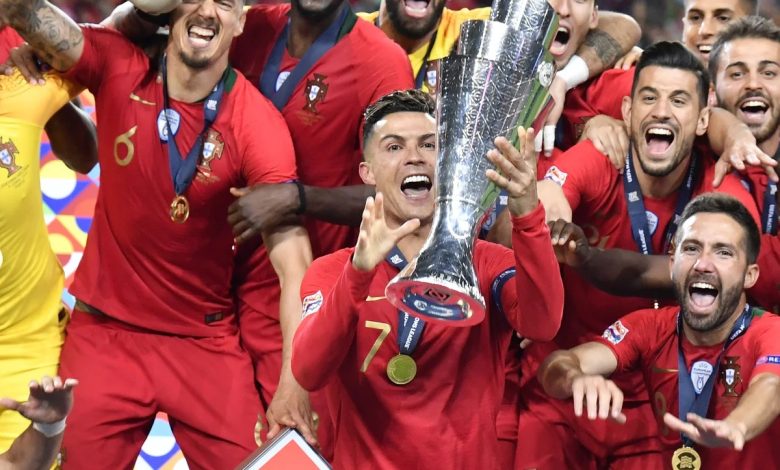
The image of Ronaldo lifting the trophy remains one of the defining photographs of his career. It was also a reminder that leadership is not always measured in goals. Sometimes it is measured in what a player gives when he can no longer play.
Portugal added another landmark in 2019, winning the inaugural UEFA Nations League on home soil. Ronaldo scored a hat-trick in the semi-final against Switzerland before Portugal defeated the Netherlands in the final. Six years later, he helped them win the competition again, scoring against Germany in the semi-final and finding the net in the final against Spain before Portugal prevailed on penalties.
The goals that refused to stop
At the 2018 World Cup in Russia, Ronaldo produced one of the most memorable individual performances in the tournament’s history. Against Spain, he scored a penalty, struck again from close range and completed his hat-trick with a magnificent late free kick to earn Portugal a 3-3 draw.
It was a performance that captured the extremes of his game: the confidence, the timing, the physical precision and the conviction that the decisive moment belonged to him.
His records continued to accumulate. In September 2020, a free kick against Sweden made him the first European player to score 100 international goals. A year later, two goals against the Republic of Ireland took him beyond Ali Daei’s long-standing world record for men’s international goals.
He became the first man to score 10 international hat-tricks, reaching that mark against Luxembourg in 2021. He also became the first player to reach 200 men’s international appearances, marking the milestone against Iceland in 2023 with a late winner.
His longevity was as remarkable as his scoring. Ronaldo found the net for Portugal in 23 consecutive calendar years, from 2004 through 2026, a run that began with his first international goal against Greece at Euro 2004.
At European Championships, he set records for the most tournaments played, with six, the most appearances, with 30, and the most goals, with 14. He scored 11 times in 27 World Cup matches, making him Portugal’s leading scorer in the competition.
The 2026 World Cup added another extraordinary chapter. Ronaldo became the first male player to score at six different editions of the tournament, having appeared at every World Cup since his debut in 2006. At 41 years and 147 days, he also became the oldest player to score in a World Cup knockout match, converting a penalty against Croatia.
Portugal’s campaign ended in the last 16 against eventual champions Spain. The one prize that had eluded him — the World Cup — remained beyond reach.
The ending was less triumphant than the career deserved.
Ronaldo’s final appearance for Portugal came in a 1-0 win over Wales on September 24, when he was substituted in the 67th minute. A disagreement with coach Jorge Jesus followed after he was left out of the next match. Ronaldo left the team camp, received a 30-day suspension and later apologised.
There had been speculation that he would return, but Thursday’s announcement ended that possibility. He did not dwell on the dispute in his farewell message. Instead, he spoke about the moments that had made the journey worthwhile.
“There were perfect afternoons and nights. There were victories I will never forget. There were defeats that still hurt to remember. I made mistakes; I suffered,” he said.
“There were also moments when I couldn’t give the Portuguese people what they so desperately wanted. But I never gave up. And above all I never stopped feeling proud to represent Portugal.”
The Portuguese Football Federation said it would organise a fitting tribute to a career that transformed the national team and its place in world football.
Ronaldo’s departure also closes one side of a sporting rivalry that defined an era. Lionel Messi, his long-time counterpart, has also ended his international career with Argentina. The two leave behind different stories, but a shared legacy of numbers and achievements that may never be matched.
There is still football ahead. Ronaldo remains under contract with Al-Nassr in Saudi Arabia, and his pursuit of 1,000 career goals continues. But the Portugal shirt, the one he wore for more than two decades, now belongs to someone else.
When he first appeared for his country in 2003, he wore No. 17 because Luis Figo owned the famous No. 7. After Figo’s retirement, Ronaldo claimed it and turned it into a symbol recognised far beyond Portugal.
Now he says it is time to pass it on.
The number will remain. The records will remain. And somewhere in Portugal, a generation that grew up watching Ronaldo will have to get used to a national team without the player who made its biggest dreams seem possible.